
Quantum Theory
Combining Probability Amplitudes
Quantum theory is based on amplitudes that define events. We have seen the two-slit experiments and their conclusion. We need to expand on this.
Dirac Bra-ket Notation
Paul Dirac introduced the bra-ket notation to describe the derivation of amplitudes. The result is always a complex number that is the amplitude.
The bra defines an final condition which is a function that maps a vector to an amplitude.
The ket is a vector defining the initial condition of the event.
It has to be read from right to left!
First general principle in quantum mechanics
The probability that a particle will arrive at x, when emitted at the source \(s\), can be represented quantitatively by the absolute square of a complex number called a probability amplitude, in this case, the “amplitude that a particle from s will arrive at x”.
The amplitude itself is a complex number.
Second general principle of quantum mechanics
When a particle can reach a given state by two possible routes, the total amplitude for the process is the sum of the amplitudes for the two routes considered separately. In the case of two slits.
Third general principle of quantum mechanics
When a particle goes by some particular route the amplitude for that route can be written as the product of the amplitude to go part way with the amplitude to go the rest of the way. For example the amplitude to go from s to x via hole 1 is equal to the amplitude to go from s to 1, multiplied by the amplitude to go from 1 to x.
Using this notation we can rewrite Equation (5).
Particle Scattering
Consider an experiment where two particle sources \(A\) and \(B\) are on the \(x\) axis facing each other. There are two moveable detectors at an angle \(\theta\). We need to determine the probability of a particle reaching a detector.
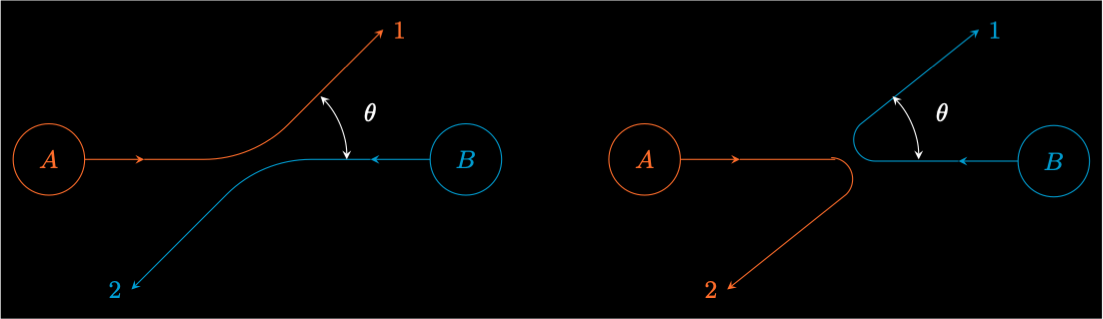
Figure 1 shows that there are two ways in the which the two particles can scatter.
The important question is "Is it possible to determine which way the particles scatter?".
Distinguishable Particles
In an experiment, the particles emitted from \(A\) are alpha particles and the particles emitted from \(B\) are oxygen atoms. Now detector 1 can only detect alpha particles and detector 2 can only detect oxygen atoms. This is the left diagram of Figure 1. The amplitude of detecting a particle at either detector is \(f(\theta)\) and the probability is \(|f(\theta)|^2\).
It both detectors can detect both particles then both scattering paths can be detected. Then both types of particle also have an amplitude of \(f(\pi-\theta)\). In this experiment we can’t determine which type of particle has been detected, but we can change the experiment so that we can. So, we have to add the probabilities, not the amplitudes, to get the probability of detecting a particle at a detector.
If it is possible to determine which path a particle took then we have to add the probabilities!
Identical Particles
If we repeat the experiment shown in Figure 1 with identical particles then there will be interference because it is impossible to determine which path a particle took.
If it is impossible to determine which path a particle took then we have to add the amplitudes!
We have to add a phase difference to an amplitude \(\phi = e^{i\delta}f(\pi - \theta)\). Note that \(|\phi| = |f(\pi - \theta)|\) even with the phase.
Given that we have to add a phase factor when we exchange the roles of two identical particles.
If the particles are exchanged again then we must get the same results as before the exchange. This means that \(e^{i\delta} = \pm 1\).
If the particles are bosons (photon, W, Z, gluon) then the phase is \(+1\).
If the particles are fermions (electron, muon, tauon, quark) then the phase is \(-1\).
Spin
If the particles are fermions, then spin changes the rules. Each particle can be spin up or spin down.
If the two particles have the same spin then the path can’t be determined, so the amplitudes need to be subtracted.
If the two particles have opposite spins, then the path can be determined, so the probabilities have to be added.