
Astro-Mathematics
Eclipse Position
Given the date that a solar eclipse occurs, for time \(t\) UTC during the eclipse, the Besselian elements can be calculated. These elements need to be transformed to the longitude and latitude of the location on the Earth’s surface. The Besselian elements will be given a b subscript for example \(x_b\).
Coordinate Axes
A coordinate axis system is required for coordinate transformations that must be related the the Besselian Fundamental Plane.
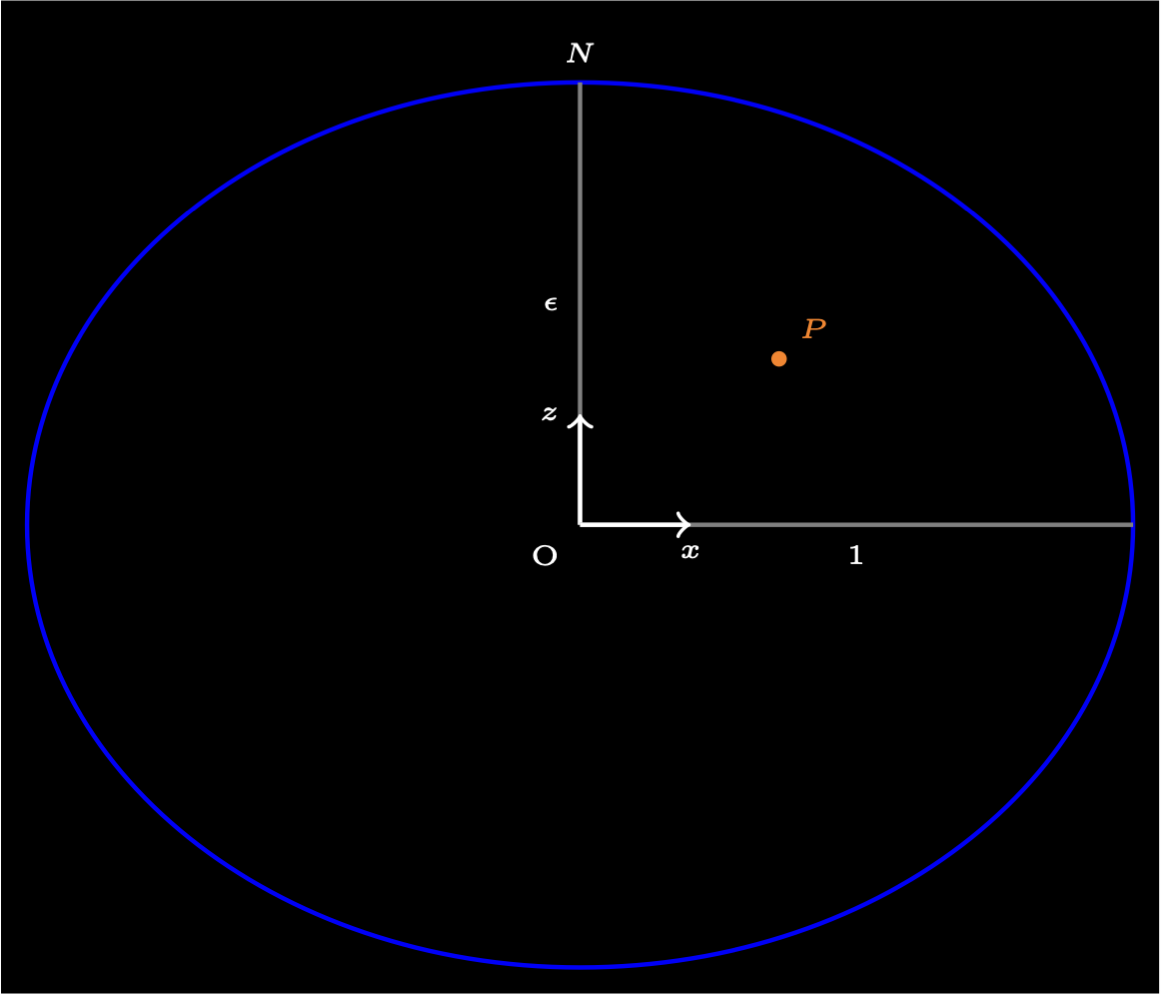
Figure 1 shows a cross section through the Earth that passes through the centre of the Earth and the poles. The Earth is an ellipsoid, the diagram exaggerated the eccentricity. The accepted value is \(e^2 = 0.006694540\).
The origin is at the centre of the earth \(O\) and the \(z\) axis points in the direction of the North Pole.
The \(x\) axis is coincident with the \(x\) axis of the Fundamental Plane. The \(y\) axis points backward.
The Earth’s radius will be defined to be \(1\). The semi-minor axis.
The shadow code axis meets the Fundamental Plane atthe point \((x_b, y_b)\). It’s declination is defined by a Besselian element that needs to be converted from degrees to radians \(d = d_b\pi/180\). The transformation from the Fundamental Plane to cartesian coordinates requires an X rotation of \(-d\). The shadow code can now be defined by the point Y.
The unit direction \(\hat{n}\).
Ellipsoid Intersection
The Earth can be represented by an ellipsoid.
The cone centreline.
Substitute \(x\) from Equation (5) into Equation (4) rearrange and let \(\xi^2 = 1 - x_b^2\).
Equation (6) describes an elliptic cross section through the Earth that is parallel to the YZ plane and contains the shadow cone centreline.
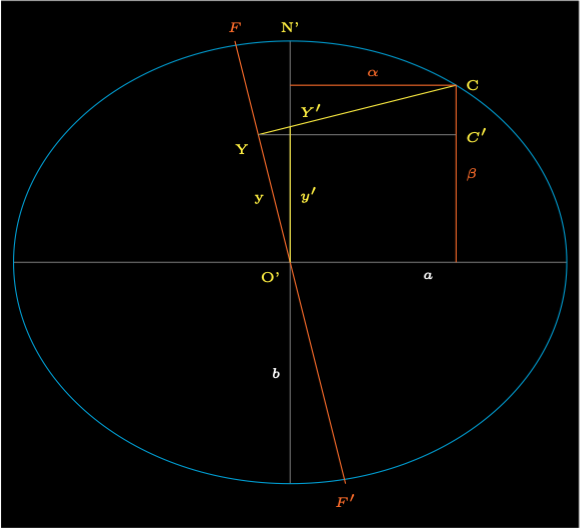
The coordinates of the intersection of the shadow cone axis and the Earth’s surface \(C = (x_b, \alpha, \beta)\) are required.
Substitute \(y\) and \(z\) from Equation (5) into Equation (6) and rearrange.
Expand the squares and collect the \(\lambda\) terms.
Use the quadratic equation to solve for \(\lambda\). Take the positive square root solution. If there are no real solutions, then the shadow axis doesn’t intercept the Earth’s surface.
Calculate the coordinates of the intersection of the shadow cone axis and the Earth’s surface \(C = (x_b, \alpha, \beta)\) using Equation (5) and the value of \(\lambda\).
Shadow Code Axis Coordinates
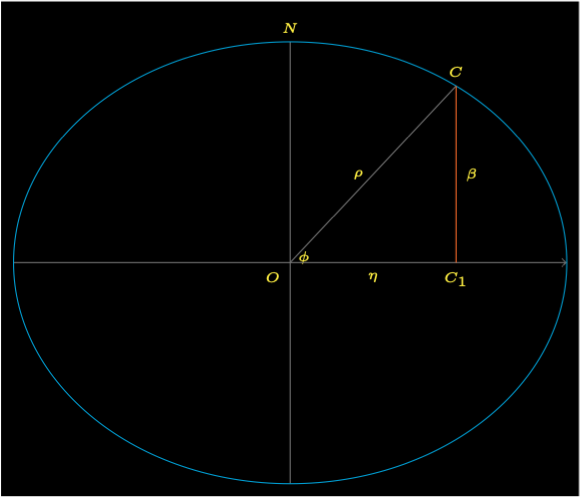
Figure 3 shows the ellipse that is the plane through the points \(O\), \(N\), and \(C\). The distance \(OC_1\) is \(\chi\).
The latitude \(\phi\) is:
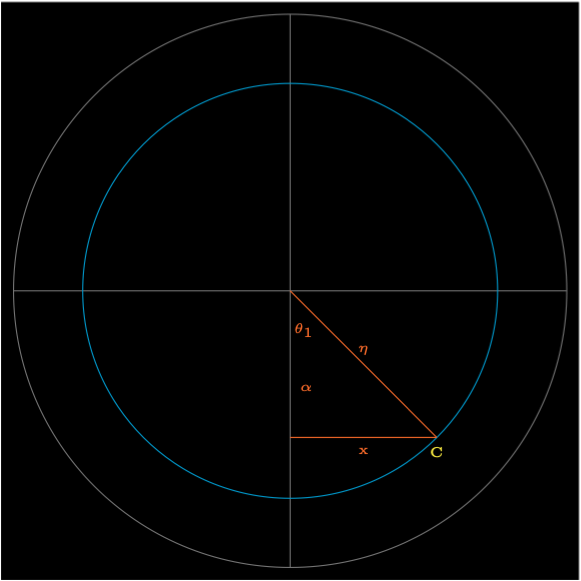
Figure 4 shows the plane of the latitude of where the shadow axis intersects the Earth’s surface. The radius of the circle of latitude is OC. The Besselian element \(\mu\) is the hour angle of the shadow axis. The angle \(\theta\) is angle at point \(C\).
The longitude \(\lambda\) can now be calculated. It needs to be converted into the range \(-\pi < \lambda \le \pi\).
Umbral Cone Vertex
The vertex of the umbral cone needs to be calculated.
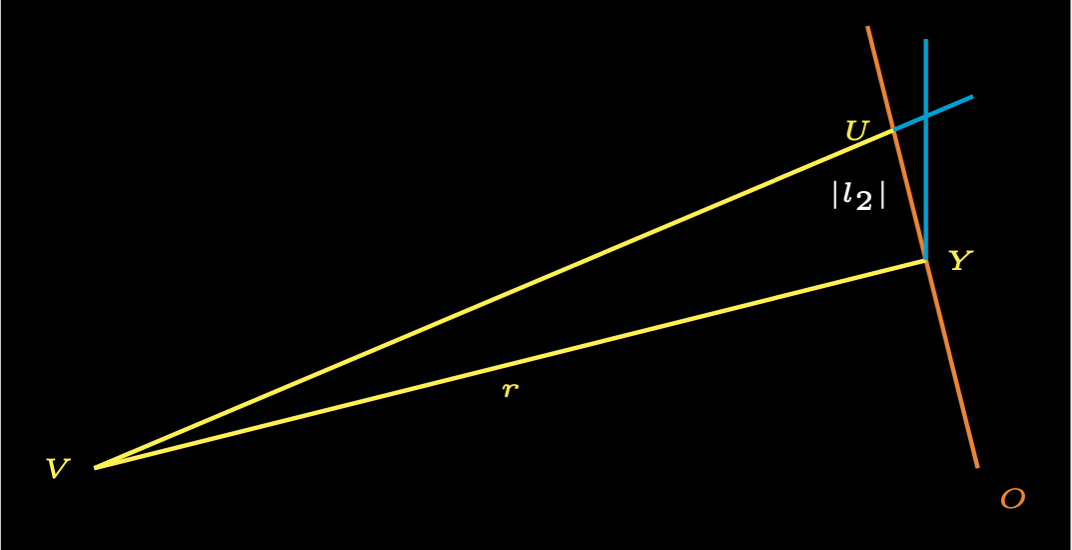
Figure 5 shows a close up of the YZ plane where the umbral cone meets the Fundamental Plane at point Y. The shadow cone axis needs to be projected back to the cone vertex point V. The umbral cone intersection with the Fundamental Plane is a circle. The radius of the circle is the Besselian element \(|l_2|\). The modulus is taken as by convention \(l_2 < 0\).
The angle \(f_2 = \widehat{YVU}\) is defined by the Besselian element \(\tan f_2\). The distance YV can be defined.
The vertex position can be calculated from point Y and the shadow cone axis direction.
Cone North and South Limits
It is easier to use vector notation.
-
The origin \(O = (0, 0, 0)\) is the centre of the Earth.
-
\(V = \vec{v}\) is the position of the umbral cone vertex.
-
\(\hat{s} = (0, -\cos d, \sin d)\) is the unit vector in the direction of the shadow cone axis.
-
\(f_2\) is the cone angle.
-
\(C = \vec{c} = (x_b, \alpha, \beta)\) is the point where the shadow cone axis meets the Earth’s surface.
-
\(N = \hat{k} = (0, 0, 1)\) is the Earth’s North Pole.
A point \(\vec{r}\) on the shadow cone can be defined.
The plane through the points O, N and C intercepts the Earth’s surface through an ellipse of longitude. The normal can be determined.
A vector that is orthogonal to the normal and North Pole vector.
A point \(\vec{r}\) on the plane can be defined in terms of the normal or a linear combination of the two orthogonal vectors in the plane.
Substitute Equation (18) into Equation (15) and expand vectors.
The below doesn’t work as the intersecting ellipse is in the wrong orientation.
The North and South limits of the umbral cone can be calculated by intersecting the shadow cone North and South limit lines with the Earth ellipsoid. In these cases the cone vertex point is used and the unit direction vectors change.
For the North limit.
For the South limit.